Alshabab has been on a losing streak in recent weeks, and the prospect of eradicating them bodes a secure Somalia and a great legacy for President Hassan’s administration.
Somalia is a failed state, or so any entitled pundit will tell you. Unfortunately, that is the facts; Conflicts and instability have persisted for decades, and 15 years have passed since the founding of Alshabab terror group. It is indisputable that Al-Shabab poses the biggest obstacles to Somalia’s prosperity.
There have been several efforts in the past to expel Alshabab from Somalia, but they have all been unsuccessful. However, the new government led by President Hassan Sheikh Mohamud has embarked on an extensive and radical program to eradicate Al-Shabab from Somalia, which will be the greatest success and blessing that Somalis can hope for at this time.
Alshabab is a terrorist group responsible for a significant chunk of the pain and suffering perpetrated on Somalis. Mr. Hassan has an extensive understanding of the harm inflicted by Shabab. He has consistently vowed to eradicate Al-Shabaab, and his government has made this a top priority.
If President Hassan Sheikh Mohamud is successful in eradicating Shabab from Somalia, he would go down in history as one of the country’s most respected leaders.
All-Out Battle
Following his victory, the President devised a strategy to destroy al-Shabab that included the use of military action to engage the enemy, financial restriction on the group, and widespread public education on false ideas and misconceptions of the Islamic religion.
19 August, during al Shabaab’s siege of the Hayat Hotel in Mogadishu, President Hassan released a message to the Somali people advising them to be prepared for an all-out attack on the terrorist organization. Since then, the government has been engaged in a constant conflict, which is now ongoing.
What has made this even more encouraging is the participation of major clans in the fighting against Alshabab; in some instances, clans have formed on their own and fought and defeated Alshabab in different villages, while in other instances, they have won with the assistance of the government.
In the past six months, Alshabab has lost more territory than in the prior five years combined. Some of the areas they have lost are of strategic significance and will hamper Shabab’s maneuverability, making them subject to restrictions.
Possible scenarios for the success of the battle against al-Shabab include long-term plans that involve attempts to get Ahlu Sunna wa al Jama’a (ASWJ) on board, as well as other methods; the following is a list of factors that might lead to victory.
Ahlu Sunna wa al Jama’a (ASWJ) involvements
The president is focused on recruiting Ahlu Sunna wa al Jama’a (ASWJ) and using their might in the struggle against Alshabab. If the paramilitary arm of Ahlu Sunna wa al Jama’a (ASWJ) fully joins the current struggle against Al-shabab, this would be a tremendously beneficial addition to the government’s side on the conflict.
Macawisley- the popular uprising
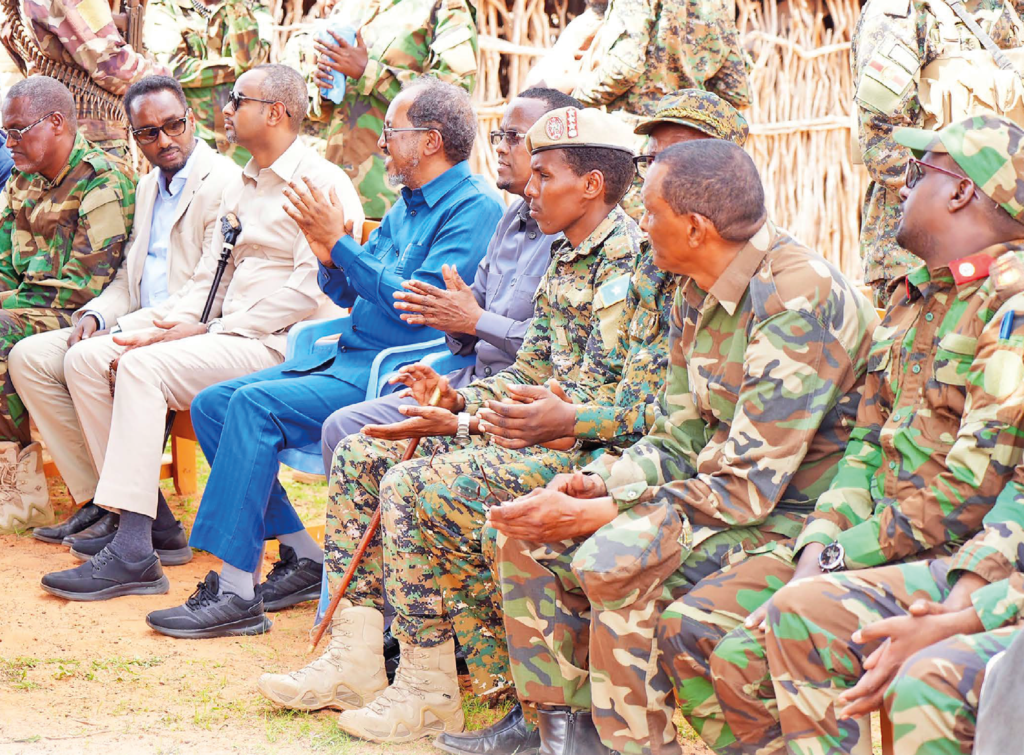
Macawisley clan-based militias launched an operation against Shabaab in the central Hiraan area of Somalia. The clan-based faction known as Macawisley has been in conflict with al-Shabab for years, although they have become more coordinated and widespread in recent weeks.
The clans are fighting in Galguduud, farther northeast, and Bay, to the southwest of Hiraan,
According to Samira Gaid, executive director of Mogadishu’s Hiraal Institute, a security think tank, the rebellion was spurred by reported al-Shabab cruelty, including cattle stealing.
“It is always the people who bear the brunt of the excesses of rule under al-Shabab and they don’t enjoy popular support,” she said. “Some populations who aren’t as armed are not able sometimes to take up arms against the group. But others are better equipped and are stronger politically to stand up against (al-Shabab) rule.” Gaid warned that for an uprising by locals to be effective, “government support logistically is critical.”
Omar Abdi Jimale, a Mogadishu-based political analyst, said the government supporting militias to fight al-Shabab could be decided after the authorities’ previous reluctance.
“Clans were unable to carry on protracted fighting because of the absence of official government support. As a result, their uprisings ultimately were ending up in signing a peace deal with al-Shabab,” he said. “The previous administration had the chance of providing direct support to the revolting clan militias without directly equipping them, but by not doing so gave al-Shabab a chance to consolidate their control over revolting clans’ territories.”
Financial Sanctions
As part of the fight, the President met with the National Committee for Combating Money Laundering and Countering the Financing of Terrorism (AML/CFT), where he urged the acceleration of the national strategy to disable financial resources that fuel violent activities of Al-Shabaab members.
The President said that a fight would be waged on economic, ideological, and military fronts against the Shabab, and he emphasized the crucial role of Somali businesspeople. A warning was also given by the President to Mogadishu based businessmen who pay tax to them noting that doing so is equivalent to being a member of Shabab and aiding their activities that includes killing innocent Somali people.
Encouraging those at the frontlines
In order to demonstrate his dedication to the battle, the President has spent several days motivating the warriors and working with the required security organization.
He visited some of the locations where operations against the Al-Shabaab militants are being conducted. During his tour, the President examined the living conditions of the troops in the Hiraan, Galgudud, and Mudug areas.
He also lauded the continuous victories in the war against terrorism through bravery and unity, and he underscored the government’s support, “As long as I am the President, the government of Somalia is determined to eradicate Al-Shabaab from the country, to eliminate any terrorism. Elbur, Haradere, Aden Yabal and other areas will be freed by God.”
If the war against al-Shabab continues at its current rate, it means that in a relatively short amount of time, al-Shabab will be a thing of the past.

Hey, like this? Why not share it with a buddy?
« Djibouti’s recent achievements and unique favorable role.Climate change: A threat to Somali people »
Related Posts